Marketing has spent the last decade optimising channels.
Search became performance.
Social became discovery.
Display became scale.
SEO became compounding growth.
Each channel built its own logic, its own metrics, its own specialists.
And slowly, without anyone explicitly deciding it, marketing stopped being about people.
It became about where to spend. Not so much, what to say.
The problem with channel first media strategy
Channel first marketing feels logical. Budgets are allocated. Teams are structured. Performance is tracked.
But it comes with a hidden cost.
It forces human behaviour into artificial boxes.
It assumes:
- Discovery happens on social
- Intent happens on search
- Interest happens through content
That is not how people actually behave.
People do not move neatly through channels. They move through states.
They discover something while living.
They develop an interest over time.
They form intent, sometimes suddenly, sometimes gradually.
These states are fluid. They overlap. They accelerate and regress. And they do not care about your media plan.
A better lens: Intent, Interest, Discovery
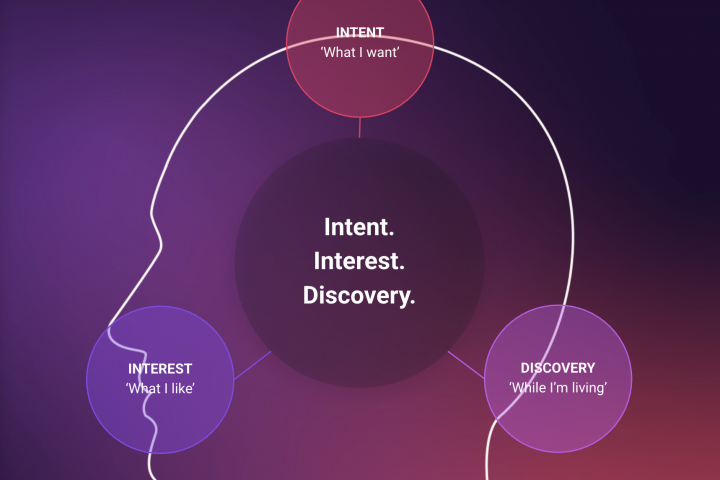
If you step back and look at the system through a human lens, three forces emerge.
- Intent — what I want
- Interest — what I like
- Discovery — what I encounter while living
These are not funnel stages. They are constantly shifting states.
A person might:
- Discover a product on Instagram while not looking for it
- Build interest through repeated exposure over weeks
- Suddenly form intent and search at 10 pm on a Tuesday
Or skip steps entirely.
This is the reality most marketing systems are not designed for.
If you are not doing this, algorithms are
Here is the uncomfortable truth.
Platforms already understand this better than most marketers.
Their algorithms:
- Track behaviour across environments
- Infer intent before it is explicitly stated
- Optimise in real time at an individual level
They are already operating in a people first way.
But they are optimising for their outcomes, not yours.
If your strategy is built around channels instead of people, you are effectively handing over control of interpretation. The platforms decide who is in market, who is not, and how your budget is deployed.
This is where waste begins.
Channels are not the strategy. They are the environment.
The strategy is understanding where someone sits between discovery, interest, and intent, and being able to respond when that state changes.
At Intender, this is the lens we build from. When you start with people, not channels, marketing stops feeling like interruption and starts behaving like alignment.