
How Brand and Non-Brand Terms Compete for the Same Click
Most marketing teams run paid search and organic search as separate disciplines, with separate owners, separate budgets and separate reporting lines. The problem is that the customer does not see two channels. They see one results page. When your brand appears as both a paid ad and an organic listing for the same query, those two placements are not always additive. Sometimes the second placement simply pays for a click you were going to get for free.
This is cannibalisation, and it behaves very differently for brand terms than it does for non-brand terms. Getting the distinction right is one of the highest-leverage, lowest-effort optimisations available to a search programme, because it usually means spending less money for the same or better outcome.
This post breaks down what cannibalisation actually is, why brand and non-brand terms behave differently, how to measure the real incremental value of paid search, and a decision framework you can apply to your own account.
Contents
- Two kinds of cannibalisation
- Why brand and non-brand terms behave differently
- The core question: incrementality, not volume
- A worked example with data
- When brand bidding is still worth it
- Sitelink count and its impact on cannibalisation
- A decision framework
- How to measure it properly
- A note on internal SEO cannibalisation
- Putting it into practice
Two kinds of cannibalisation
The word “cannibalisation” gets used loosely, so it is worth separating the two distinct problems it describes.
1. Channel cannibalisation (paid versus organic). Your paid ad and your organic listing both appear for the same query, and the paid click displaces an organic click you would have earned anyway. You pay for traffic that was already yours. This is the focus of this post and it is where the brand versus non-brand distinction matters most.
2. Internal SEO cannibalisation (page versus page). Two or more pages on your own site compete for the same keyword, splitting authority and confusing search engines about which page to rank. This is a structural SEO issue rather than a budget issue, and it is worth a short section of its own at the end.
The remainder of this post deals primarily with the first type, because that is where brand and non-brand terms diverge so sharply.
Why brand and non-brand terms behave differently
The single most important variable is organic dominance. The stronger your organic presence for a query, the more likely a paid click is simply replacing a free one.
Brand terms are queries that include your company or product name. For these, you almost always rank first organically, often with sitelinks and a knowledge panel. The searcher already knows who you are and has navigational intent. They are looking for you specifically.
Non-brand terms are generic queries describing a category, problem or product type, with no company name attached. For these, you are competing against the entire market, your organic position is variable, and the searcher has not yet decided who to buy from.
The table below sets out the structural differences.
| Dimension | Brand terms | Non-brand terms |
|---|---|---|
| Example query | “Intender pricing” | “marketing attribution software” |
| Typical organic position | 1, usually with sitelinks | 3 to 15, highly variable |
| Searcher intent | Navigational, knows you | Exploratory, comparing options |
| Organic CTR if ranked #1 | Very high (often 40 to 70%) | Moderate, shared across results |
| Competitor presence on SERP | Sometimes (rival bidding on your name) | Always, dense |
| Likely incremental value of paid | Low to moderate | Moderate to high |
| Cannibalisation risk | High | Low to moderate |
| Cost per click | Low | High |
The pattern is clear. On brand terms you tend to own the result already, so a paid ad risks paying for a click you would have captured for free. On non-brand terms you rarely own the result, so a paid ad is far more likely to win a click you would otherwise have lost to a competitor.
A note on the figures above: organic click-through rates vary widely by query type and over time, so the 40 to 70% range cited for a number-one brand listing draws on aggregated click-curve studies from sources such as Advanced Web Ranking, Sistrix and Backlinko. Read it as indicative rather than a fixed benchmark, and substitute your own Search Console data where you have it.
The core question: incrementality, not volume
The mistake most teams make is judging paid search on total conversions rather than incremental conversions. A brand campaign will always look efficient on a last-click basis, because the people clicking it were already searching for you and were highly likely to convert regardless of channel.
The right question is not “how many conversions did the brand campaign drive?” It is “how many conversions would we have lost if the brand campaign did not exist?” That second number is the incremental contribution, and it is the only number that justifies the spend.
The classic reference point is the large-scale field experiment eBay ran with the economists Thomas Blake, Chris Nosko and Steven Tadelis, published in the journal Econometrica in 2015, in which they paused brand and non-brand paid search across controlled regions. They found that brand paid search was almost entirely non-incremental, because organic listings absorbed the traffic. Non-brand paid search performed better, though even there the incremental return was lower than last-click attribution suggested. Your own numbers will differ, but the principle holds: you cannot assume paid clicks are additive, you have to test it.
A worked example with data
Consider a brand term where you already rank first organically. The example below compares a week with brand ads running against a week with them paused, holding everything else constant.
| Metric | Ads ON (brand) | Ads OFF (brand) | Difference |
|---|---|---|---|
| Total brand searches | 10,000 | 10,000 | 0 |
| Paid clicks | 2,800 | 0 | -2,800 |
| Organic clicks | 4,900 | 7,300 | +2,400 |
| Total clicks to site | 7,700 | 7,300 | -400 |
| Paid spend | $1,400 | $0 | -$1,400 |
| Incremental paid clicks | 400 | n/a | n/a |
| Effective cost per incremental click | $3.50 | n/a | n/a |
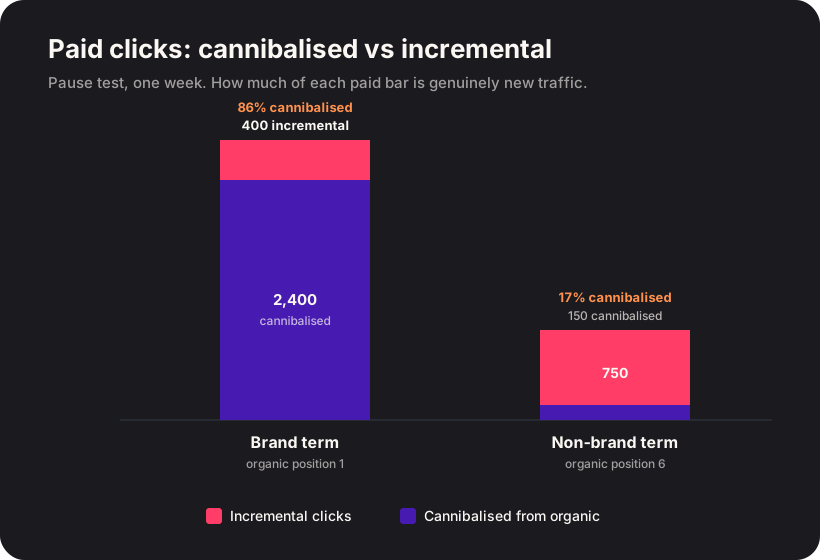
The headline finding is the one that catches teams off guard. The paid campaign generated 2,800 clicks, but when ads were paused, organic clicks rose by 2,400. So 86% of the paid clicks were cannibalised from organic, and the campaign’s true incremental contribution was only 400 clicks. The nominal cost per click of $0.50 was really $3.50 per incremental click once cannibalisation is accounted for.
Whether that is acceptable depends on two things: the conversion value of those 400 incremental clicks, and whether competitors are bidding on your brand. We will come to the second point shortly.
Now compare the same exercise on a non-brand term where you rank in position 6 organically.
| Metric | Ads ON (non-brand) | Ads OFF (non-brand) | Difference |
|---|---|---|---|
| Total category searches | 10,000 | 10,000 | 0 |
| Paid clicks | 900 | 0 | -900 |
| Organic clicks | 600 | 750 | +150 |
| Total clicks to site | 1,500 | 750 | -750 |
| Paid spend | $4,500 | $0 | -$4,500 |
| Incremental paid clicks | 750 | n/a | n/a |
| Effective cost per incremental click | $6.00 | n/a | n/a |
Here only 150 of the 900 paid clicks were cannibalised, because the organic listing in position 6 was never capturing much traffic to begin with. The campaign delivered 750 genuinely incremental clicks. The cost per click is higher in absolute terms, but the spend is doing real work rather than buying back free traffic.
When brand bidding is still worth it
Cannibalisation does not mean you should switch off brand campaigns entirely. There are specific conditions where brand bidding earns its keep even when most clicks are non-incremental.
Competitor conquesting. If rivals bid on your brand name, paused ads can hand them the top of the page. The incremental value here is defensive: you are protecting clicks from being intercepted, not generating new ones. Measure this with the auction insights report in Google Ads, which Google’s own Help documentation describes as the place to see which competitors appear alongside you and how often.

Message and offer control. Ads let you control the headline, promotion and landing page in a way an organic listing cannot. For a time-sensitive offer or a high-consideration purchase, that control can lift conversion rate enough to justify the spend.
Sitelink and SERP real estate. A paid ad with sitelinks plus your organic listing can push competitors and review aggregators further down the page. The value is in occupying space, not just earning the click. How much space you already own depends heavily on the number of organic sitelinks you display, which is covered in detail in the next section.
Weak organic presence. If your brand term does not reliably rank first, for example a new product line or a brand with an ambiguous name, the organic safety net is not there, and paid clicks become far more incremental.
The honest position is this: on a brand term where you rank first, you have no aggressive competitors bidding, and there is no special offer to promote, brand ads are the easiest budget in the account to cut.
Sitelink count and its impact on cannibalisation
Sitelinks are the additional links that appear beneath your main listing, and the number you display is one of the clearest signals of how much of the result page you already own. This matters directly to the cannibalisation question: the more organic sitelinks you show, the more clicks and intents your free listing is already capturing, and the weaker the case for paying for a brand ad on top of it.
Google shows organic sitelinks on a sliding scale from one to six. Google generates these automatically rather than letting you choose them, a point its Search Central documentation makes explicit, and the format escalates as your perceived navigational authority for the query grows. The specific one-to-six banding in the table below reflects observed practitioner experience rather than a published Google figure, so treat the thresholds as a working guide.
| Organic sitelink count | Typical format | What it signals | Approximate SERP real estate | Effect on paid incrementality |
|---|---|---|---|---|
| 0 | Single listing, no sublinks | Weak navigational authority | Small, one slot | Paid more likely incremental |
| 1 to 2 | Inline links under the listing | Emerging authority | Modest | Paid partly incremental |
| 3 to 4 | Two-line or grid sublinks | Strong, recognised brand | Large | Paid largely cannibalising |
| 5 to 6 | Full expanded grid, two columns | Dominant navigational result | Very large, owns top of page | Paid almost entirely cannibalising |
The relationship is close to linear. Each additional sitelink expands the footprint of your free listing, captures another distinct intent (pricing, login, support, careers and so on), and pushes competitors further down. By the time you display the full six, your organic result is functioning like a mini navigation menu and is absorbing clicks across the whole spread of brand intents. Paying for an ad above it at that point is buying back traffic you have already comprehensively secured.
The practical readout for each band:
Five to six organic sitelinks. You own the page. Brand ad spend here is the strongest candidate for cutting, unless competitors are actively conquesting your name. A pause test will almost always show a high cannibalisation rate.
Three to four organic sitelinks. You hold a strong position but have not saturated every intent. A capped defensive bid can be justified, especially if a competitor is bidding or you have an offer to surface in the ad copy.
One to two organic sitelinks. Your dominance is partial. Paid sitelinks can meaningfully extend coverage by surfacing intents your organic listing does not yet show, so paid clicks carry more incremental value.
Zero sitelinks. Treat the term closer to a non-brand term. Your organic safety net is thin, and paid is doing real acquisition work rather than recapturing free clicks.
One caution on paid sitelinks specifically: a paid ad can display its own sitelink assets, typically two to six. Stacking six paid sitelinks above an organic listing that already shows six creates heavy duplication, where the same destinations appear twice on the page. That redundancy is a strong visual indicator that the ad is adding footprint rather than incremental clicks, and it is worth flagging in any audit.

A decision framework
Use the matrix below to decide whether to bid, reduce or pause for any given term. The two axes are the organic position you hold and the level of competitor pressure on the SERP.
| Scenario | Organic position | Competitor bidding | Recommended action |
|---|---|---|---|
| Brand, dominant | 1 with sitelinks | None | Pause or minimal defensive bid |
| Brand, dominant | 1 with sitelinks | Active | Bid defensively, cap budget |
| Brand, weak | 4 or lower | Any | Bid, treat as quasi non-brand |
| Non-brand | 1 to 3 | Any | Reduce bids, test for cannibalisation |
| Non-brand | 4 to 10 | Any | Bid normally, monitor incrementality |
| Non-brand | 11+ or unranked | Any | Bid, paid is the primary channel |
The principle running through every row: the stronger your organic position, the lower your paid bid should be, because the marginal paid click is buying back traffic you already own.
How to measure it properly
You cannot manage cannibalisation from inside a single platform, because Google Ads will never show you the organic clicks you would have earned without ads. You need to bring data together and, ideally, run a controlled test.
1. Join paid and organic data by query. Export Google Search Console query data and Google Ads search-term data, then match them on the query string. This shows you, for every term, how paid and organic clicks coexist. Pay particular attention to terms where you rank first organically and still spend heavily on ads.
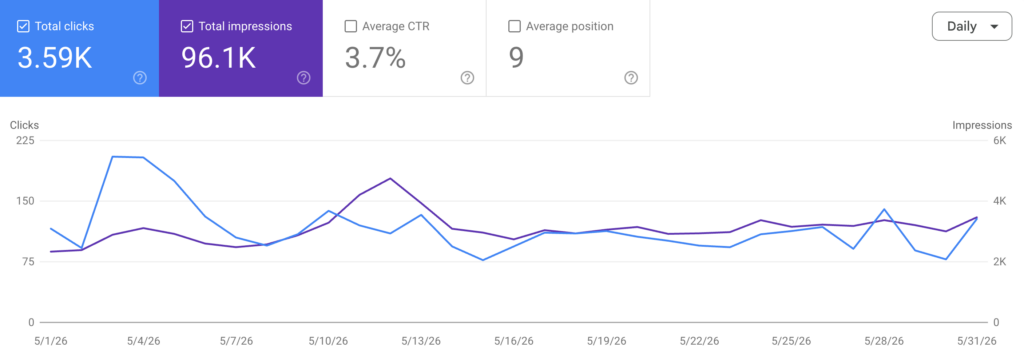

2. Run a pause test. The only reliable way to measure incrementality is to stop bidding and watch what happens. Pause brand ads in a controlled region or for a controlled period of one to two weeks, then compare total clicks and conversions against a matched baseline. The rise in organic clicks is your cannibalisation rate. The shortfall in total clicks is your true incremental loss.
3. Use geo holdouts for non-brand. For non-brand campaigns where a full pause is too risky, split regions into test and control groups, suppress paid in the test group, and compare outcomes. This isolates incremental effect while controlling for seasonality and market movement. The method is well documented: Google’s own researchers, Jon Vaver and Jim Koehler, set out the geo-experiments approach in a 2011 paper, and it remains the basis for most credible incrementality testing today.
4. Track effective cost per incremental click. Re-cut your reporting so that paid efficiency is expressed against incremental clicks and conversions rather than total ones. This single change reframes the entire brand-spend conversation for finance and leadership.
A note on internal SEO cannibalisation
Separate from the paid-versus-organic problem, internal cannibalisation occurs when several of your own pages compete for the same keyword. Search engines split ranking signals across them, and none ranks as well as a single consolidated page would.
You can spot it in Search Console when one query returns multiple URLs from your domain with rotating positions, or when a page’s ranking is unstable and never settles. The fixes are well established in standard SEO guidance from sources such as Ahrefs, Moz and Search Engine Journal: consolidate thin or overlapping pages, redirect the weaker URL into the stronger one, differentiate intent so each page targets a distinct query, and tighten internal linking so the canonical page receives the clearest signals.

Putting it into practice
If you do nothing else after reading this, do three things. First, identify your highest-spend brand terms and check whether you rank first organically for them. Second, run a short pause test on those terms and calculate your cannibalisation rate. Third, re-express your paid search reporting in terms of incremental clicks and conversions rather than totals.
Cannibalisation is rarely a reason to abandon paid search. It is a reason to spend it where it does real work: on non-brand terms where you do not yet own the result, and on the defensive brand scenarios where competitors are circling. The goal is not to win the click. It is to win the click you would otherwise have lost.
